


Say Goodbye to "Top-and-Bottom Gluing": How Light-Curing 3D Printing Achieves Seamless Internal Channels in Ceramic Robotic Arms
Say Goodbye to "Top and Bottom Adhesion": Photocuring 3D Printing
How to achieve monolithic molding of internal air channels in ceramic robotic arms?

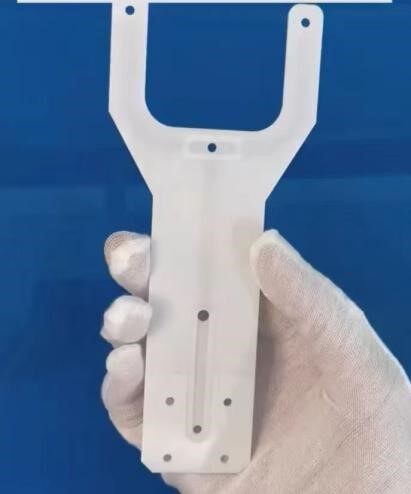
The image above shows a ceramic mechanical finger assembled by bonding with adhesive in traditional machining.
In today's rapidly advancing semiconductor industry, ceramic robotic fingers—core components of wafer-handling end-effectors—are increasingly replacing traditional metal grippers in precision manufacturing due to their superior hardness, wear and corrosion resistance, and excellent electrical insulation. However, manufacturing these ceramic robotic fingers has long faced significant bottlenecks. Overcoming the limitations of conventional machining to deliver higher-performance, cost-effective, and faster-turnaround products has become a critical challenge for the semiconductor sector.
Where are traditional crafts stuck?
Anyone who has worked with ceramic fixtures knows that building robotic arms with traditional methods is a hassle. Currently, there are two major issues:
1. Severe constraints in the molding stage.Processes like dry pressing, isostatic pressing, and injection molding all rely on molds to define the final shape. However, robotic arms are often thin-walled, hollow, and feature complex internal curves—making it difficult for any single process to produce them in one step. As a result, the industry standard is to split a complete arm into multiple sections, form each separately, and then bond them together.
This leads to issues: the adhesive bond ages easily and leaks, shortening product lifespan and compromising wafer suction performance.
Additionally, adhesive materials often struggle to withstand extreme conditions such as high cleanliness and corrosion resistance requirements.
Every additional connection point introduces a new risk of stress concentration.
2. Long development cycles and slow response times.From finalizing designs to tooling, trial runs, mold modifications, and small-batch validation—the process easily takes two to three months. Clients often push for urgent delivery while the molds are still being prepared; this anxiety is something anyone in this industry knows all too well.
3D printing doesn't just make things better—it changes how we do things.
The logic behind SLA 3D printing of ceramics differs fundamentally from traditional methods. It uses a UV laser to cure layers of alumina slurry with a solid content as high as 85%, eliminating the need for molds and removing geometric constraints.
Unprecedented freedom to design.SLA photopolymer 3D printing builds parts by curing layers one at a time, free from the geometric constraints of traditional molds. Designers can now create complex structures that were previously impossible—such as multi-finger linkages, biomimetic joints, internal channels, and lattice-based weight reduction. Crucially, the entire robotic arm can be printed as a single monolithic piece in one go: no part splitting, no assembly, and no post-processing beyond sintering. This eliminates weak connection points at their source and removes issues like glue leaks entirely.
Regarding accuracy,SLA curing can achieve layer thicknesses as fine as 50 microns, allowing complex structural features to be formed during printing. The thinnest sections can reach 0.25MM. However, due to stringent requirements for the flatness of the ceramic robotic arm, a machining allowance must be预留ed in the green body prior to printing, followed by secondary precision machining after sintering.
The change in development speed is more pronounced.With an STL file, you can reprint the same day. From 3D printing the green part to debinding and sintering, the entire process takes as little as 5-7 days. No molds required—no waiting. For R&D teams that need rapid iteration, this turnaround time is a real competitive advantage.
Less material waste.Traditional machining is subtractive manufacturing: a large portion of the ceramic blank is cut away, and the resulting waste is largely unusable. 3D printing is additive manufacturing: uncured material can be reused, achieving material utilization rates above 90%.
 Image shows a 3D-printed ceramic robotic arm (6 inch)
Ceramic 3D Printing Capabilities at Shuzao Technology:
For over 22 years since its founding, Shuzao Technology has been deeply committed to the field of stereolithography (SLA) ceramic additive manufacturing under the leadership of Dr. Zhao Yi from Xi'an Jiaotong University. Our core product line now spans from 100-type to 500-type SLA ceramic printers; models 300 and 450 are specifically designed for fabricating ceramic mechanical fingers.
3DCR-300,Molded dimensions 300 × 300 × 200 mmcovers the vast majority of 3D printing needs for small and medium-sized robotic arms and fingers; 3DCR-450,Molded dimensions 450 × 450 × 300 mm, enabling integrated printing of large-scale robotic arms and multi-finger arrays. Used together, the two systems cover mainstream size requirements—from small precision grippers to large industrial manipulators.
Combining large-scale forming capabilities with high-precision SLA technology, Shuzao Technology's ceramic 3D printers enable end-to-end manufacturing of ceramic robotic arms—from design to final product. We have already provided prototyping and custom solutions for numerous domestic semiconductor companies and ceramic manufacturers, offering ceramic robot fingers ranging from 6 inches to 12 inches. This approach significantly shortens delivery cycles and reduces overall manufacturing costs. The image shows the 3DCR_100 ceramic 3D printer by Shuzao Technology.
Conclusion
From "separate manufacturing" to "integrated molding," from "mold dependency" to "digital direct drive," stereolithography (SLA) 3D printing is reshaping the manufacturing paradigm for ceramic robotic arms. Shuzao Technology will continue to drive the advancement of ceramic additive manufacturing through technological innovation, empowering industry clients to gain a competitive edge in smart manufacturing.
Related Articles
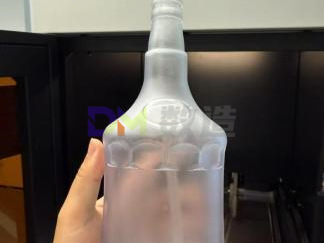
3D Printed Wine Bottle Packaging – Glass-Like Finish, Embossed-Level Precision
SLA 0.1mm layer thickness precisely reproduces embossed dragon patterns, matte textures, and complex irregular bottle shapes. Transparent photopolymer resin, after polishing and UV curing, achieves a glass-like visual appearance.
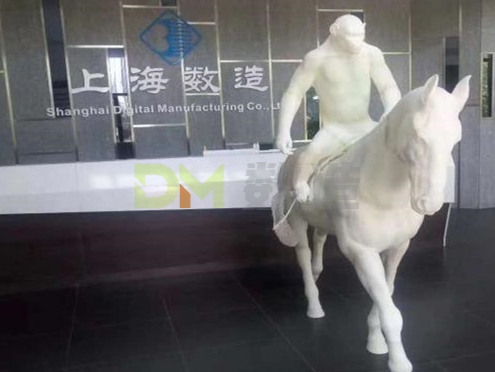
3D Printing Ad Exhibition - Large-format Splicing, 72-Hour Rush Service
SLA large-format machines enable rapid production of high-precision models, including people, buildings, product lines, simulations, and miniature dioramas.
3D Printing in Healthcare – Preoperative Planning & Customized Devices
SLA 3D printing uses patient CT/MRI data 1:1 to create bone and vascular models for surgical planning and team collaboration.